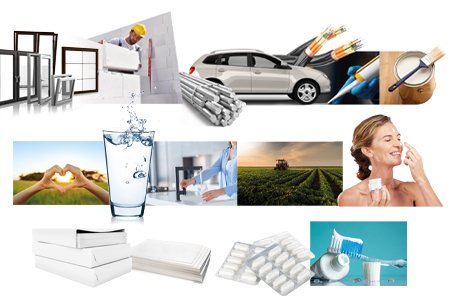


- The use of lime is at the beginning of a large number of industrial value chains in Germany and Europe.
- Regional lime production with high quality standards secures our customers' supply chains and contributes to local value creation.
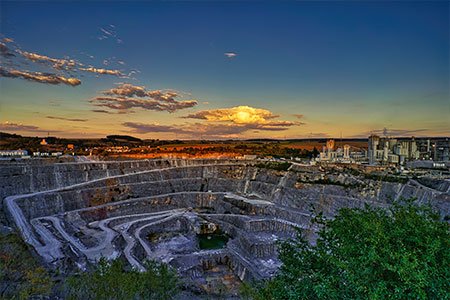
- Supplying our plants with raw materials from our own quarries and our regional proximity to our customers are also important factors in reducing emissions. This avoids long-distance truck transports and reduces CO2 emissions.
Where possible, we deliver large quantities by rail.
![[Translate to Englisch:] Voraussetzungen Transformation - Frauen im Werk](/fileadmin/_processed_/0/0/csm_Darum_Dekarbonisierung_Titel_d54940d814.jpg "[Translate to Englisch:] Voraussetzungen Transformation - Frauen im Werk")
Requirements for a Successful Transformation
Competitive and Secure Supply of Renewable Energy
Decarbonisation increases the demand for renewable energy, particularly green
electricity, but also biomass. Ensuring sufficient quantities of renewable energy at
competitive costs is a key prerequisite for the success of decarbonisation.
CO2- and H2-Infrastructure
The process CO₂ generated during lime production must be captured and transported for reuse or storage, which requires pipelines and storage facilities.
In the long term, green hydrogen could provide a solution for emissions from fossil
fuels. This requires, on the one hand, the availability of sufficient green hydrogen at
economically viable conditions, and on the other hand, the establishment of a transport infrastructure via pipelines.
Establishing a Legal Framework
The Carbon Capture, Utilisation, and Storage (CCUS) Act must be implemented to
provide legal certainty. Regulations for onshore storage can create additional
opportunities for CO₂ storage.
Economically Viable Framework Conditions
The necessary technological renewal requires significant investments in new
technologies and leads to higher operating costs for companies. These additional costs exceed the savings from reduced emissions. Therefore, investment and research
support programs, as well as effective carbon leakage protection in international
markets, are required to maintain the competitiveness of the industry.